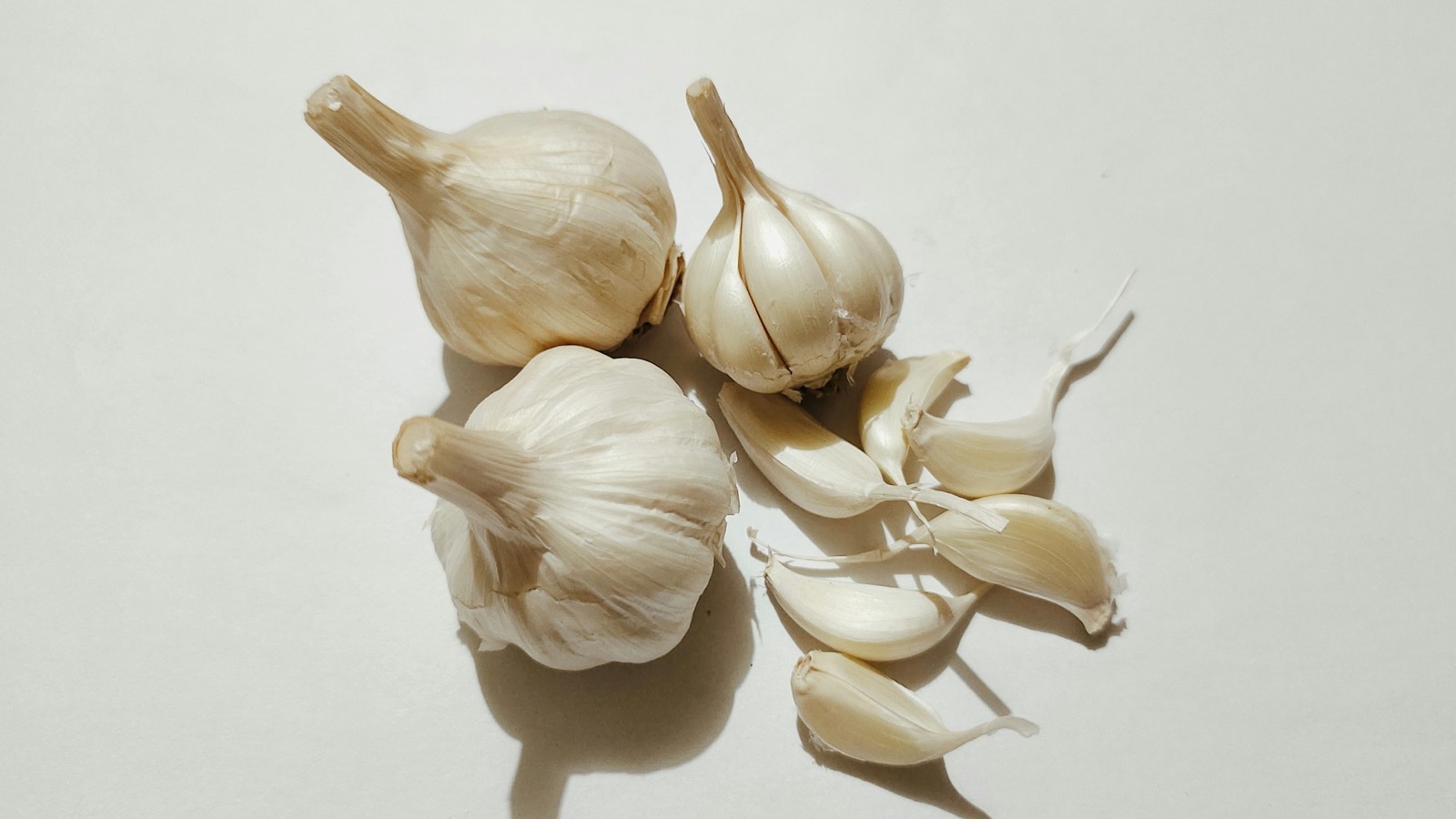
Ask around and someone will tell you about a relative who ate raw garlic every summer and never got bitten. It is one of the most durable folk remedies in outdoor life, repeated in gardening columns, travel guides and roughly nine hundred videos of people eating cloves on camera.
The claim has actually been tested. Twice, in two properly controlled trials, on two different animals, with two different answers. Almost every article written about garlic quotes one of them and ignores the other, which is why the myth refuses to die and why the debunking never quite convinces anyone.
Here is the whole picture.
The mosquito trial
In 2005, a team at the University of Connecticut Health Center ran a randomized, double-blinded, placebo-controlled crossover study on 49 volunteers. Each person attended twice, consuming garlic on one visit and a placebo on the other, without knowing which was which. They were then exposed to laboratory-reared Aedes aegypti.
The researchers did not just count bites. They measured how many mosquitoes declined to feed at all, how many bites each person received, how much the mosquitoes weighed afterwards, and how much blood they had taken. Four separate ways of asking the same question.
The data showed no evidence of significant systemic repellence. One measure did shift slightly in a statistically detectable way, but the authors judged the difference too small to mean anything biologically.
Two caveats belong with that result, and the authors were upfront about both. They labeled the study preliminary, and they tested short-term consumption only. Whether weeks of garlic would do anything different is a question the trial was never designed to answer.
Source: Rajan TV, Hein M, Porte P, Wikel S. Medical and Veterinary Entomology, 2005;19(1):84-89
The trial nobody quotes
Five years earlier, two Swedish researchers ran a randomized, double-blind, placebo-controlled trial on 80 marines. The dose was 1,200 mg of garlic a day for two weeks, considerably more sustained than a couple of capsules before a lab session.
The garlic group recorded significantly fewer tick bites.
That finding was published in JAMA in 2000, and it is a large part of why the folk belief has survived so well. It also comes with real limitations. It is a one-page research letter rather than a full paper, the methodology attracted criticism in the years that followed, and when another researcher wrote in asking whether the result extended to other biting arthropods, the authors replied plainly that they had studied ticks only and had made no comparison with any other repellent.
So it is one suggestive trial, not a settled finding. But it is a real one, and pretending it does not exist is how debunking articles lose readers who have heard about it.
Source: Stjernberg L, Berglund J. "Garlic as an insect repellent." JAMA, 2000;284(7):831
Why both results can be true at once
Nothing about these two studies is contradictory once you stop treating biting insects as a single category.
Mosquitoes find people using carbon dioxide from breath, body heat, and the cocktail of odors produced by bacteria living on skin. They hunt actively over distance. Ticks do not. They wait on vegetation and respond to a host at very close range, using a different sensory toolkit entirely. There is no particular reason a compound circulating in sweat should register the same way to both.
The doses were also nothing alike. A single serving of garlic before a lab exposure is not the same experiment as two weeks of daily supplementation. And "fewer bites recorded over a fortnight in the field" is a genuinely different measurement from "does this mosquito land and feed under controlled conditions".
Two studies, two species, two protocols. One answer each.
The part of the garlic story that is straightforwardly bad advice
Crushing raw garlic and rubbing it on skin turns up regularly in remedy lists, and it should not.
The sulfur compounds that give garlic its smell are irritants in direct contact. Dermatology case reports document contact dermatitis and chemical burns from prolonged skin exposure to raw garlic, with children particularly affected. There is also no trial anywhere supporting it as a topical repellent, so the trade is real harm against no demonstrated benefit.
Eat it. Do not wear it.
The question underneath the question
The garlic debate is usually framed as "does it work", which is too blunt to be useful.
Eating something that alters your body odor is an attempt to make you less interesting to an insect that is hunting by smell. Applying something to your skin is an attempt to interfere with that insect at close range once it has already found you. These are different mechanisms with different evidence behind them, and they get flattened together every time someone writes a listicle about natural remedies.
Most folk repellents fail not because plants are useless, but because a claim about diet gets tested as though it were a claim about topical application.
Where we stand
We make plant-powered repellents, so people occasionally expect us to defend every natural remedy in circulation. We do not. Botanical does not mean beyond scrutiny, and a remedy that survives on anecdote alone is not doing our category any favors.
Our own coconut-oil-based spray is a formulated topical product, applied to skin and reapplied every two hours per the label. That is a different proposition from a dietary hack, and it should be judged on different evidence. Whichever repellent you reach for, the habit worth keeping is the same one the researchers used: ask what is actually in it, and ask what was actually measured.
The Wild Bunch Naturals Journal follows mosquitoes, plants, repellents and the changing science of outdoor life.