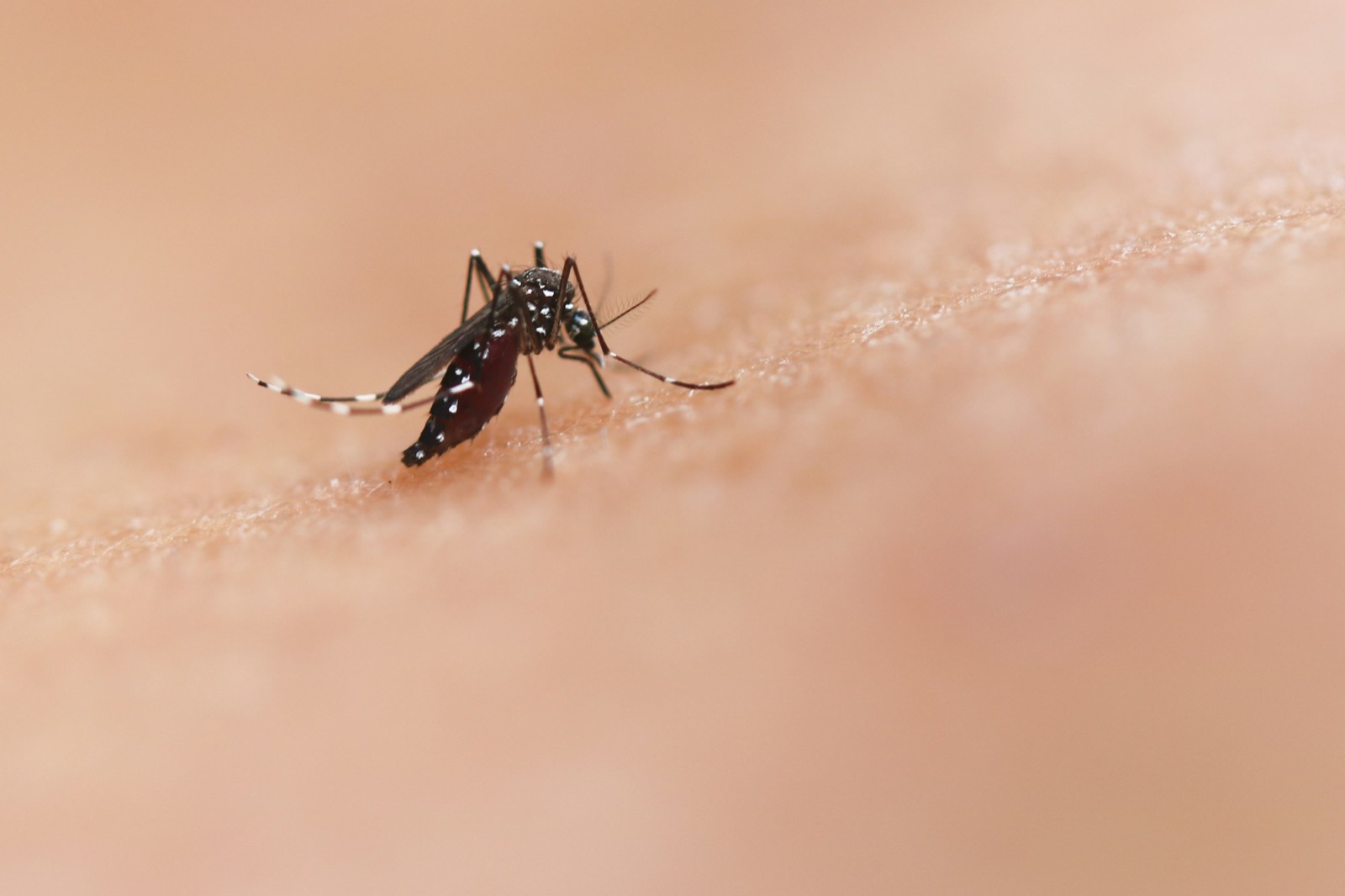
Aedes aegypti has been found in Britain four times. Only once has it bred here, and that was at a handful of residential addresses in east London, confirmed by the UK Health Security Agency in early September 2026.
The papers ran it as an arrival story. Tropical mosquito reaches Britain, dengue and Zika in the standfirst, heatwave blamed. But arrivals are the boring part. Invasive mosquitoes turn up in northern Europe constantly, in lorries, in baggage, in imported pot plants. Most of them die.
What decides whether a species becomes part of a country is not whether it can breed in August. It is whether its eggs are still viable in March. Nobody writes that headline, which is a shame, because it is the only part of the story with a plot.
What made this one a first
The detection was adults and larvae together at residential properties, which is the difference between a passenger and a resident. Control measures went in, trapping was stepped up, and the surrounding area was searched.
Dr Jolyon Medlock, UKHSA's head of medical entomology, put it as accidental importation. Mosquitoes hitchhike, and if the climate suits them, they persist. His next sentence is the one that got cut from most coverage: despite the breeding, and despite the heatwaves, the species is not established here and cannot survive long term in a UK climate that is too cold overall.
That is not a hedge. It is the specific technical claim the whole story turns on. Aedes aegypti has never overwintered anywhere in northern Europe. Several outlets ran the heatwave as the cause of the finding, which reverses what UKHSA actually said. The heat is not why it bred. Whether it lasts is a question about the cold.
How a mosquito colonizes a continent
For the version of this story with three decades of data behind it, you have to look at a different insect.
Aedes albopictus, the tiger mosquito, reached Europe in the early 1990s, largely in the global trade in used tires, which hold rainwater beautifully and get shipped between continents by the million. It settled in France around 2004. It is now established in 16 European countries and 369 separate regions. Ten years ago the figure was 114.
That is not modeling. It is a distribution map that has already been redrawn, region by region, while nobody outside entomology was paying much attention.
The European Centre for Disease Prevention and Control puts the acceleration down to a combination of things: warmer temperatures, longer summers, milder winters, changed rainfall, and international travel running at volumes that keep supplying new introductions.
Trade delivers the eggs. Climate decides the outcome.
Albopictus is the more capable colonizer of the two because its eggs are more tolerant of cold. It got a foothold in temperate Europe that aegypti has not. If you want to know what Britain's mosquito future looks like, watch the tiger mosquito, not the yellow fever one.
A mosquito arriving is not a disease arriving
This is where most reporting collapses two different things into one, and it is worth pulling them apart.
Aedes albopictus can carry dengue, chikungunya and Zika. Carrying requires the virus to be present. ECDC is direct about this: dengue is not endemic in the mainland EU or EEA, and neither is chikungunya. Almost every European case arrives in a traveler.
What has changed is the arithmetic. When the vector is established across 369 regions instead of 114, an infected traveler returning home is far more likely to be bitten somewhere the mosquito can pass it on.
The virus is imported. The mosquito is the multiplier.
And the multiplier is working. Europe recorded 27 chikungunya outbreaks in 2025, a continental record, with 111 confirmed infections in France and seven in Italy. Most sat where you would expect, in the south and south-east. One did not. A locally acquired case turned up in Alsace, which ECDC flagged as exceptional at that latitude and read as the transmission risk moving north.
West Nile virus is doing something similar through a different vector, the common Culex. In the 2026 season to early August, ECDC identified 59 affected areas across seven countries, including Italy, Greece, Romania, North Macedonia, Spain, France and Germany.
ECDC has taken to calling this the new normal. Surveillance agencies do not reach for that phrase casually.
The Zika sentence nobody writes carefully
Zika does most of the work in headlines and has the least European evidence behind it, so it deserves an accurate sentence.
There has been one documented episode of mosquito-borne Zika transmission in Europe. August 2019, three locally acquired cases in one neighborhood of Hyères in the Var, all living within about 90 meters of one another. All three recovered. It was the first known transmission of Zika by Aedes albopictus anywhere in Europe, and the investigation was written up in Eurosurveillance.
ECDC's assessment at the time noted that a sporadic case in southern France was, given where the vector had spread, not unexpected.
That is the whole European Zika record. Three people, one street, one summer, seven years ago. It proves the mechanism exists and tells you almost nothing about scale. Chikungunya is the virus breaking records. Zika is the one selling papers.
What the work actually looks like
Britain has been watching for this since 2010. The main instrument is an ovitrap, a water-filled container designed to appeal to a female mosquito looking for somewhere to lay. They sit at ports, airports, service stations and distribution centers, and get checked fortnightly between June and October.
When invasive eggs appear, the national contingency plan sends entomologists to inspect a 300-meter radius for anything holding water. Puddles, buckets, tires. They drain it or treat it, put adult traps out, and keep monitoring for weeks.
The east London finding did not come from a trap, though. It came from Mosquito Watch, the citizen science scheme where members of the public report what is biting them. You can post specimens in. The guidance asks you to freeze them for ten minutes first, pack them in something crush-proof, and use separate labeled containers for different locations, which is the most quietly British paragraph published by any government department this year.
It works because Aedes aegypti is a domestic animal in the literal sense. It breeds in containers, close to people, in the water sitting in a plant pot or a blocked drain or a water butt without a lid. That is why the London find was in houses rather than marshland, and why UKHSA's advice to residents is to go and tip things out.
Back to January
Medlock's last point is the one worth holding onto. He expects incursions of invasive mosquitoes to keep coming, and expects increasing reports of them surviving here for longer.
Not establishing. Surviving longer. That is a gradient, not a threshold, and it is the thing to watch over the next decade. Every mild winter shortens the odds slightly. At some point the question stops being whether a tropical mosquito can breed in a London summer, which we now know it can, and becomes whether a temperate one can hold on through a London February.
Nobody has that answer yet. The traps are out.
The Wild Bunch Naturals Journal follows mosquitoes, plants, repellents and the changing science of outdoor life.